
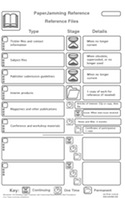
 Regular readers know that my freelance writing business is completely “on the rings.” From creation to disposal, almost every printed document I work with ends up in a Rollabind or Circa notebook. I have Circa notebooks for administrative documents, project files, and permanent archives. For admin files, I use punched poly folders. For project files, I use Jotz Refillable Notebooks.
But for the permanent records — as defined in my PaperJamming schedules — I decided to do something different. I transferred permanent records to their own Rollabind notebooks once they were no longer needed in the admin or project folders, which I stored in plastic file boxes. While this method worked fine, it lacked a certain elegance — that sense of modular panache which Rollabind and Circa users have come to expect from these systems.
What I wanted, in other words, was a Circa-fied approach to hanging folders.
 Last week I had the pleasure of being interviewed by Stephanie Diamond of the
  Would you deliberately set fire to your family’s photo albums? Wantonly wave an electromagnet over cassette recordings of your child’s first words? Smash your copy of the White Album into fragments with a hammer? Shred your grandparents’ love letters?
 Shortly after I introduced the latest round of Active Voice productivity templates for the Hipster PDA (hPDA — available as free downloads
  On Tuesday, I participated in a webinar hosted by
  For freelance writers, it’s all about the clip. All your research files, interview transcripts, and notes are there to help you create a professionally written product. But what do you do with the rest?
 Journalist Xeni Jardin recently discussed the perils of storing and deleting government e-mail on her weekly NPR spot,
  I rely on three things to administer my freelance writing business: paper files, electronic files, and e-mail. I’ve already written about how I use
  Not only are freelance writers their own bosses, they are also their own administrative assistants. And every doubling of duty results in a halving of available time. That’s one of the reasons that freelancers represent such a large proportion of the audience for organizational systems like David Allen’s Getting Things Done, Merlin Mann’s 43 Folders, and planners like Day-Timer and Franklin Covey.